This is a summary of learning for my EC&I 831 last Masters Class! Many times I felt out of my comfort zone in this class…but I do believe this needs to happen for learning to occur. Thank you to everyone who took time out of your day to read my blogs and make comments.
Social Activism “refers to a broad range of activities which are beneficial to society or particular interest groups. Social activists operate in groups to voice, educate and agitate for change, targeting global crisis.” (Ghobadi, 2018) The primary goal of social activism is to do good for society through various activities and movements such as Greenpeace.
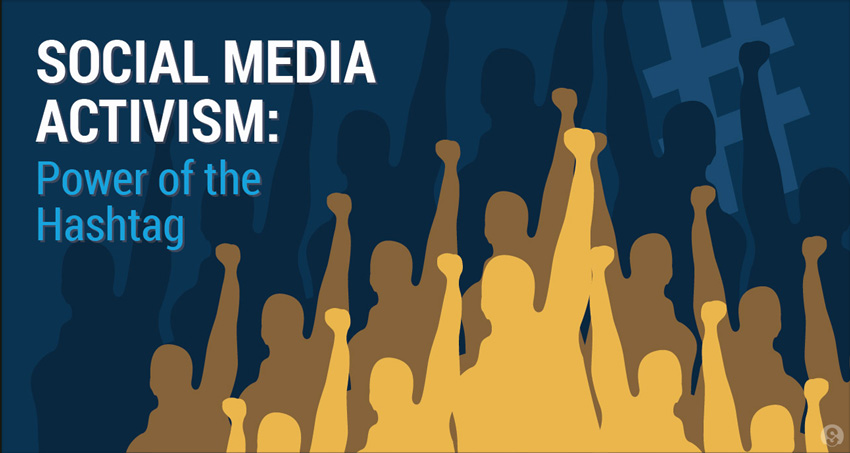
Social Media Activism refers to online activism that “allows activists to organize events with high levels of engagement, focus and network strength.” (Ghobadi, 2018) The activists use various forms of social media to engage in online activism. The primary good of social media activism is still to promote good in society with a more collective effort.
Seems simple? One form of activism is done through activities such as letter writing, protests and in person conversations and the other is through social media-facebook, twitter, blogs and any other type online media. Although the two are meant to be similiar- in many ways they are different. Many of the differences are not only through the way people communicate, but rather the type of dialogue that is communicated.
Differences
I feel that Social Activism is more “old school” and that the people who grew up with protests and wanting social change through actions are primarily the activists. These people may not be able to see the benefit of words unless they are on a picket sign or in the areas that they feel passionately about. There is something to be said about getting out from behind your computer and facing the issues in a protest with others or seeing the effect your efforts have on people.
Social Media Activism can be much easier to engage in compared to Social Activism and the fact that it can be done with the click of a key or a hashtag would make it appear that more people are engaging in the issue. However, the risks to this are that many times people can write words that they may not normally have said and “hide” behind their computer or device.
“The ways in which people come together, voice their opinions, and protest have changed and evolved over the years. With the introduction of technology, this has allowed for a new avenue to disseminate widespread movements. Viral marketing campaigns to gain support has proved to be a very effective alternative to physically collecting in the streets to voice concerns.” (El Abbassi, 2019)
Online Social Activism
Throughout time, there has been activism. Wars, movements and change have arisen from people being activists. Online social activism can prove to be meaningful to society today as the world evolves and changes. People use technology more and more to share their ideas and viewpoints, however I do feel that it is how we share that is the important key. How are we treating others-either online or in person should not matter. Online activism can see huge results and high engagement, however, it is how we use this to make good in society. I feel at times that I see the world through rose colored glasses and truly feel that people need to be kind to each other, online or in person.
As I continue on in my first online class, I notice that people tend to be much more honest online… I see people who need to share everything about themselves and what is happening in their lives to people who rarely share anything. Twitter can be seen as a forum for sharing personal stories or to follow others journeys, Facebook is seen as a more personal side of online media, Instagram as a quick picture story or even followers on Pinterest can comment and follow your boards. As in life-people can be positive or negative, however sharing on online media tends to be more brutally honest.
Absolutely!
Meaningful and productive conversations can happen about social justice online! I reflected on this as I read the blog post titled “In online spaces, silence peaks as loudly as words” where the author discusses how silence speaks as loudly as works and went further to describe “So here’s my argument:I have a responsibility to use my privilege to speak out and use my network for more than just my own benefit or self-promotion; not doing so is a selfish act.” (Hildebrandt, 2015) I am not sure I agree with this statement, but need to think about and reflect. It was interesting reading the comments people felt compelled to write following the post and I question many things- Am I one of the privileged who should be speaking out? When does silence speak louder than words? What topics of social justice am I passionate about? What is the best online media platform?
Responsibility of Educators
Our responsibility to engage in active citizenship online that can be see as a type of role model for our students is huge…as I believe in daily life outside of social media to be positive role models is just as huge. Our students, whether we realize this or not, “look up to us”. As a nursing instructor, my students look to me in how I dress in clinical, how I interact with patients or even how I perform skills. We need to remember this! Many times I have students tell me that they have looked me up on Facebook or Instagram to “creep me” or see my views. That is why I often keep silent on social media-but after reading some online articles this week, I feel it also a social responsibility to be a more responsible digital citizen in this world. To embrace the social media outlets we have and use it responsibly. “Instead of focusing on the problem and the need for change, activists can share information that explains why and how the current situation has been created and what can be learned for the future. Online activism in such manner can gradually lead to the development of people who are capable of generating new knowledge and wisdom to respond to changing social environments.” (Ghobadi, n.d.)
I have struggled with this topic. I am not even sure why, other than I feel almost old school. I have reflected on some of my own values and judgements over the last couple of weeks about open education and what it means to me.
What is open education to me?
I first had to decide about what is open education in my eyes. As an instructor in adult education, I see open education as a system that gives open access to all resources including articles, textbooks and online material at no charge in order to advance knowledge. It would be free access that could be utilized by students in order to gain knowledge and be accessible not only throughout their education, but also after they graduate. It could essentially mean that all information be open to access by all. That textbooks would be online and free, articles online and free and that all knowledge will be online, accessible to all and collaboration would assist all in the acquisition of knowledge.
Who pays? Here lies the dilemma…who should pay for all of this sharing of knowledge? Should there be licenses, copyrights, journal subscriptions or textbooks in print? Should educators be encouraged to download information and alter it in order to better serve their students?
My opinion…I personally love a hard copy book. I don’t enjoy reading articles or information online, but would rather print it out- touch the paper, highlight important information, make notes and turn pages.
I have never been able to grasp the concept of a Kindle or other type of online reader since I love bookmarking and actually turning the pages. I have also never been one for sharing my favorites…whether it be a textbook or a novel. Although I feel that open education resources should be shared, I wonder about how people will get paid for their knowledge and whether it will be fair. That being said-does it have to be an all or nothing concept? Could there be open education for some and not?
Who benefits the most? The people who will benefit the most from open education are those who can utilize the resources the most…students. Although educators will benefit in terms of being able to use these resources, students gain the most knowledge from the open education and its resources. I found it interesting to read about what is happening across Canada https://bccampus.ca/2019/02/19/canada-oer-group-2019-update/
Do I think Open Educational Resources can be sustainable?
After much deliberation, I have come to terms that this really isn’t for me to decide. The world will keep turning and open educational resources will continue to be provided to who needs them. I do feel that it is up to all of us to ensure that it is appropriate and the people who need it the most get what they need.
Learning for nursing students can be seen as mundane and old school with little opportunities for innovative learning strategies. Its time for nursing instructors to take the time to engage their students with some new strategies. Yes, these are still some of the same ideas that they teach in a 4 hour jam-packed lecture, but rather in a smaller setting with more opportunities for interaction.
Most nursing students work hard. Its a grueling 4 year degree program and typically the learning occurs not only in the classroom, but hands on in a teaching hospital providing direct patient care. The clinical time in the hospital can be exhausting with patient contact, observing, learning and applying theory to practice. Nursing instructors typically want the most learning opportunities for their students…how can we ensure they are gaining as much experience as possible.
Clinical time is spent doing as many “tasks” as we can. As there are more and more students with less clinical time, instructors need to maximize learning opportunities. Not only that, but depending on where a student is placed depends on what experiences they will gain. BUT…what if we developed nursing student tutorials that could help the students apply their classroom learning. before we get to the hospital? What if there was specific and standard learning tools that could be utilized by our program for the benefit of applying theory to practice?? Standard material that is used by clinical instructors during clinical time to ensure all students get the same educational experience.
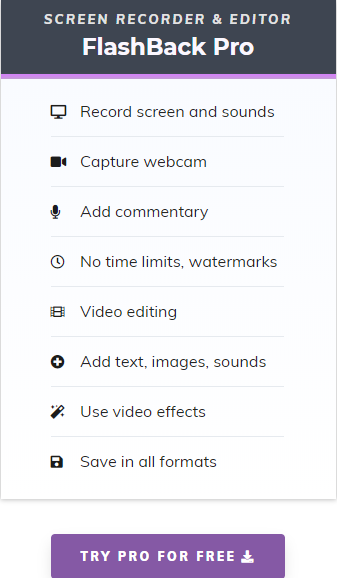
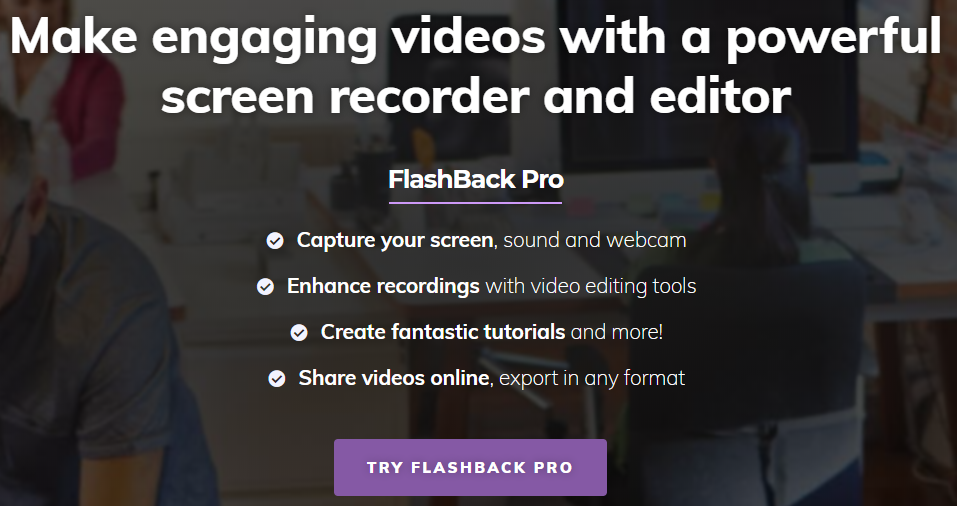
The Flashback Pro is a downloadable educational tool that could be used for creating these “tutorials”. It appears easy to use for the beginner like me with many instructions as you go. Videos can be added in and special effects. The tutorials can even be downloaded to Youtube for other instructors to easily gain access!
Some ways that we can use Flashback would be with ECG interpretations, aseptic techniques, pathophysiology of a disease, ABG interpretation or even simple techniques like handwashing.
I have contemplated the subject of knowledge over the past few days. Where is knowledge headed? What is the future of teaching in a world where knowledge is becoming obsolete? Since I see myself as a Nurse first and teacher second, it becomes difficult for me to think about how things are changing as I am not directly located in the classroom, but a clinical setting. It also becomes a question of self reflection…what works for me to learn, to teach and to be effective at both.
Pavan Arora’s Tedtalk stuck with me. We all know that knowledge is changing, but how do we adapt. The idea of Access is huge. HUGE. How do we teach our children to access the knowledge and decipher, apply and assess. As a nursing instructor…I find that my students can not learn in a classroom or hospital ward everything they will need to know to be excellent nurses. They will need to know how to access the information needed, assess the validity and apply.
Teaching in a world where knowledge is obsolete could actually be reworded to suggest that the world shouldn’t seem so big in a world where knowledge is shared and accessible by all. If we are to make knowledge accessible by all, we can share and be creative in our delivery methods with standards to follow. Imagine all of the opportunities this could potentially open up to our students?
Nursing students could learn what wound care is effective in China, what homeopathic therapies work in Australia, how aseptic technique is the same in Alaska as here! Not only does it provide a platform on what others are doing around the world, it allows networks to form, partnerships across cultures and languages to merge and so much more!
As reflected on my children who are still in school and not as a nursing instructor, I felt that familiar wonder of how are we bringing the social networks into the classroom. At times it is frightening to think of all that is available to our children and what is changing at such a high speed. I found the above link interesting in terms of how we can use the social media to learn and how it can be used in our classrooms. What was interesting to see was the comparison of a classroom from 100 years ago comparing it to one today. There are still desks, students and a teacher-arranged differently, but humans are still learning.
The factor that concerns me the most is the moral aspect. What morals is my child being taught? In the first or second class, Brad (a fellow student) talked about how he feels cell phones should be allowed in classrooms and how they can be utilized…yes, I do listen Brad 🙂
Light bulb moment
It was then that my brain clicked in. Why are cell phones in the classroom seen as such a bad thing? Don’t get me wrong, I see the negatives….but when we explore the positives and discuss, the norms and values can be discussed as well. Etiquette needs to be discussed, boundaries and privacy talked about, the social rules and the moral implications need to be explored. That is part of teaching students in a world where social media is quickly becoming the norm.
My relationship with social media has been a bumpy, short road. I feel like the majority of people who started out on Facebook and have slowly progressed to Snapchat. I use Pinterest daily for creative inspiration and rely on google to search other topics. I also am a bit out of my league…have never tweeted or twittered and a blog of my own is over the top. But here I am🤷🏻♀️. Social media has always seemed almost scary- I read people posts that give way too much personal information about themselves or show inappropriate photos and think to myself often that less is more. I’m not the type to post frequently and there are rarely pictures of my inner circle posted. Things have to be pretty big for me to share. In my professional life I am also careful- I don’t want negative attention brought to my name through social media. Any upsides have included the use of my creative thoughts. I enjoy searching for new ways to do things like paint furniture or what to plant in my garden.
I have been putting this off…trying to get over it in my mind. Totally out of my comfort zone and wondering why and how. But- this will pass. I just have to take the first step and type. I keep saying I’m too old for this – but I’m not. I keep thinking I’m technologically challenged- but it’s not so bad. I keep thinking I don’t have time – but it doesn’t take long.









 first ever blog